
One of Latin America's largest financial institutions unified data center operations with Cisco Nexus One to drive agility, sustainability, and security for millions of customers.
5 min
From days to minutes
Reduced infrastructure provisioning time from 72 hours or more to just 5 minutes using self-service automation.
40%
Improved sustainability
Reduced network energy consumption by 40%, supporting the bank's status as one of the world's most sustainable corporations.
200+
Zero operational impact
Completed more than 200 maintenance windows during a two-year migration without any impact to the bank's operations.
40,000+
Migrated at massive scale
Moved over 40,000 virtual machines, 120,000 endpoints, and 400 network devices across four new data center fabrics.

Breaking the network bottleneck
As one of the largest financial institutions in Latin America, Banco do Brasil supports a massive ecosystem, with over 74 million customers, more than 10,000 branches and service points, and 86,000 employees. For more than two centuries, the bank has been a pillar of the Brazilian economy, but legacy network infrastructure has gradually become a barrier to digital agility.
The bank's network architecture relied on traditional switching with decentralized management, where configuration changes were manual and prone to human error. This legacy environment suffered from throughput bottlenecks and scalability challenges, making it difficult for the bank's networking team to keep pace with business demands.
"The legacy network architecture limited our ability to respond with the agility required by the business, making service deployment more time consuming," says Ana Carolina de Oliveira Christofaro, IT Team Manager at Banco do Brasil. "Longer provisioning lead times and limited visibility increased operational effort and extended troubleshooting cycles."
To reverse this trend and to continue to establish itself as a leader in technology-driven financial services, the bank needed to transition from a hardware-centric network model to a software-defined architecture. The bank needed to deliver advanced automation, streamline CI/CD integration, and leverage real-time telemetry.
An "anti-fragile" migration
Modernizing the data center network of a critical national financial institution is akin to changing the wings on an airplane midflight. The bank launched a massive two-year project to migrate to Cisco ACI with the latest Cisco N9000 switches, deploying four distinct fabrics across its production, non-production, hosting, and big data environments. The infrastructure overhaul encompassed over 40,000 virtual machines, 120,000 endpoints, and 400 network devices.
The defining constraint of the project was termed the anti-fragile challenge: the team had to build the new network environment from scratch and migrate all applications—without violating the bank's strict 99.9% availability service level agreement (SLA). Any downtime could result in significant financial losses and reputational damage. To navigate this complexity, Banco do Brasil worked in lockstep with Cisco Customer Experience (CX) and their partner, NTT Data.
Adopting an agile methodology, the combined team executed 34 sprints and produced over 300 technical documents to guide the transition. The migration required intense coordination, involving over 500 IT professionals and hundreds of maintenance windows. Many of these windows took place after midnight, with upwards of 100 professionals working simultaneously to ensure precise execution. "We completed more than 200 maintenance windows during this two-year project without any impact to the operations of the bank," notes Lilian Beti de Lara, IT analyst. "That was a great achievement." Adds Christofaro: "The presence of five Cisco CX engineers and two architects embedded with the bank's team was instrumental. They assisted with everything from design validation to documentation to writing scripts for automation."


From zero to hero
The transition to Cisco ACI has fundamentally altered the culture and operational velocity of Banco do Brasil's IT department. By leveraging the automation capabilities of Cisco ACI and the unified visibility of Cisco Nexus Dashboard as the on-premises operational model for Nexus One, the team successfully transformed the network from a bottleneck into a service-oriented platform.
The most immediate impact is speed. The time needed to provision network resources for new server activation plummeted from 72 hours to just 5 minutes. This shift was enabled by a self-service portal that allows developers to request and deploy infrastructure automatically, without requiring manual intervention from a network engineer.
This efficiency has redefined the role of the network team. "Now, everyone knows what Cisco ACI is," explains Christofaro. "People say, 'You changed my life, you changed the way I do business.'" Freed from repetitive manual configuration tasks, network engineers have evolved into infrastructure consultants, approaching their work more like developers and using Ansible playbooks and automation tools to proactively improve the environment rather than reacting to trouble tickets.
Stability has also improved dramatically. Since the implementation of Cisco ACI, the environment has been extremely stable, allowing leadership to focus on strategic growth rather than damage control.
Securing transactions and enhancing sustainability
Beyond operational agility, the Cisco ACI modernization has delivered measurable improvements in performance, resilience, and risk reduction. Under peak processing conditions, the legacy environment experienced intermittent packet loss, which could impact application behavior and complicate troubleshooting.
With the higher throughput and reliability of the Cisco ACI fabric, the new infrastructure has effectively removed transaction processing latency in the data center environment, helping critical banking applications sustain higher transaction volumes with fewer timeouts and improved overall consistency. According to Marcos Lelis de Freitas, Solutions Manager at Banco do Brasil, "This evolution demonstrates the importance of a robust and predictable network architecture to support the continuous advancement of the bank's digital services."
Speed is also essential for Brazil's instant payment ecosystem, including PIX. With the new infrastructure, transaction processing latency has been substantially improved, enabling a faster and more predictable customer experience while helping the bank remain aligned with the applicable performance expectations for instant payments.
Additionally, the project reinforces Banco do Brasil's standing as one of the world's most sustainable banks. By consolidating hardware and deploying the latest energy-efficient Cisco Nexus hardware, the new network infrastructure achieved a 40% reduction in overall energy consumption versus the legacy network deployment. This aligns perfectly with the bank's mission to drive not just economic development but social and environmental benefits.
Observability and AI readiness
Looking ahead, Banco do Brasil is directing its efforts toward end-to-end observability as a strategic priority. The bank's objective is to progressively enhance the use of Cisco Nexus Dashboard, strengthening its ability to analyze and understand network behavior while gradually moving from a predominantly reactive model toward more proactive and predictive approaches.
The initiative focuses on expanding visibility, improving data consistency, and making better use of the telemetry data already available in the Cisco environment, establishing a solid foundation for the continued maturation of network observability to increase operational awareness and support more informed decision making in alignment with the bank's governance and control principles.
The modernized network infrastructure also lays the foundation for future advancements related to artificial intelligence. Banco do Brasil is closely monitoring initiatives focused on applying AI to network governance, operations, and monitoring, as they become technically mature and aligned with the institution's operational needs.
"The partnership with Cisco has helped us modernize our data center infrastructure and advance our networking capabilities to support the bank's continued digital growth. With the recent updates, we've built an AI‑ready foundation to power both traditional and AI workloads as data demand from cloud applications, AI, and big data environments continues to grow in the coming years," concludes Christofaro.
The bank's modernized environment also aligns with the Cisco Nexus One approach to unified operations, giving teams a stronger foundation for observability and future innovation.
Outcomes
Data center networking
Reliable banking at peak demand
Critical banking apps and instant payments now run consistently, even at peak volume, so customers get fast, dependable service every time..
Automation
More time for higher-value work
Self-service provisioning frees network engineers from routine requests, letting them spend more time improving the environment.
Management
Clearer insight and faster fixes
Unified visibility across all four data center fabrics helps teams spot issues sooner and troubleshoot with confidence.
AI Infrastructure
Ready to scale for what's ahead
An energy-efficient, modern network gives the bank room to grow cloud, big data, and AI workloads without another major overhaul.
Products used
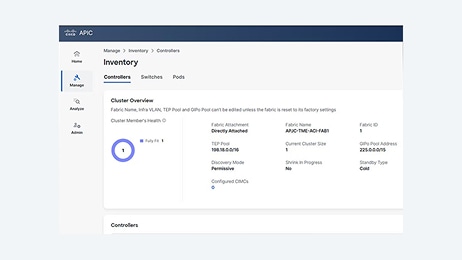
Cisco ACI
Simplifies data center network operations with policy-driven connectivity to accelerate secure, consistent deployments.
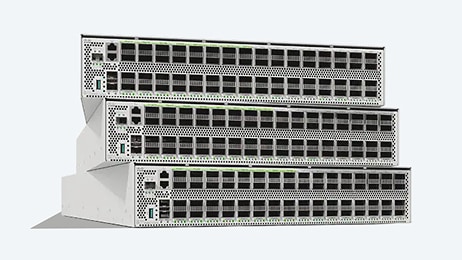
Cisco N9000 Series Switches
Built on Cisco silicon, N9000 switches deliver industry-leading data center performance from the inside out, scaling as you grow.
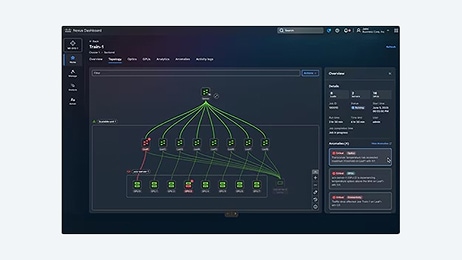
Cisco Nexus Dashboard
The on-premises management plane for Nexus One, bringing analytics, visibility, and streamlined workflows to every data center fabric.

Cisco Services
Human expertise and AI efficiency combine to deliver personal, proactive, and predictive services that support dynamic business needs.